
CanaryTank™
A patented computer-vision system that records a population of adult zebrafish 24/7, analyzes their behavior in real time and alerts staff when something happens. Available in two versions, base and 3D, with PiscisTrack™ software included.
CanaryTank Base and CanaryTank 3D
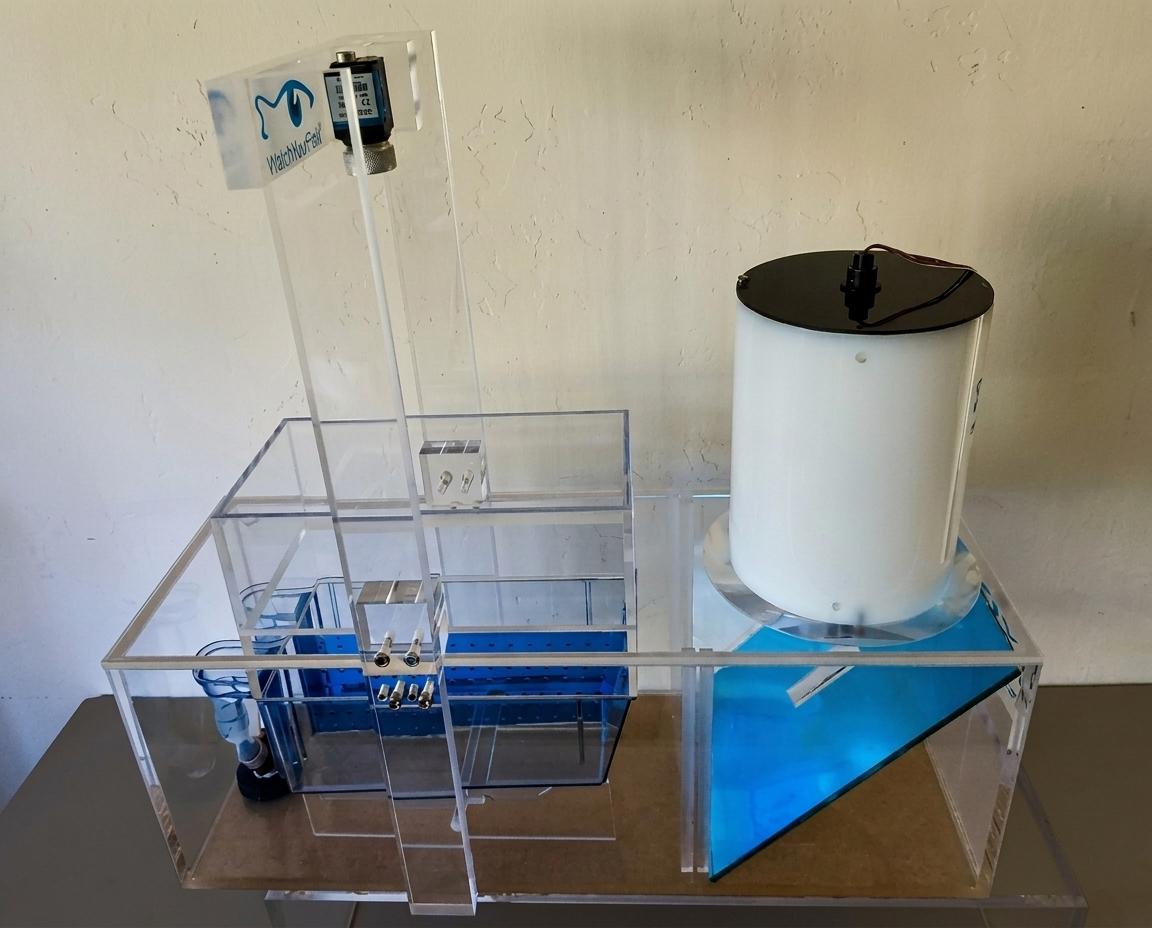
CanaryTank base
Top-view recording of either:
- one population in a standard Aquaneering aquarium, or
- two populations side by side in a Tecniplast compartmented aquarium. One camera and one processing chain record and analyze both groups, for example study and control.
All-acrylic construction, an escape-prevention structure instead of a lid (no fogging), simplified feeding, and an acrylic Fresnel lens in the beam expander.
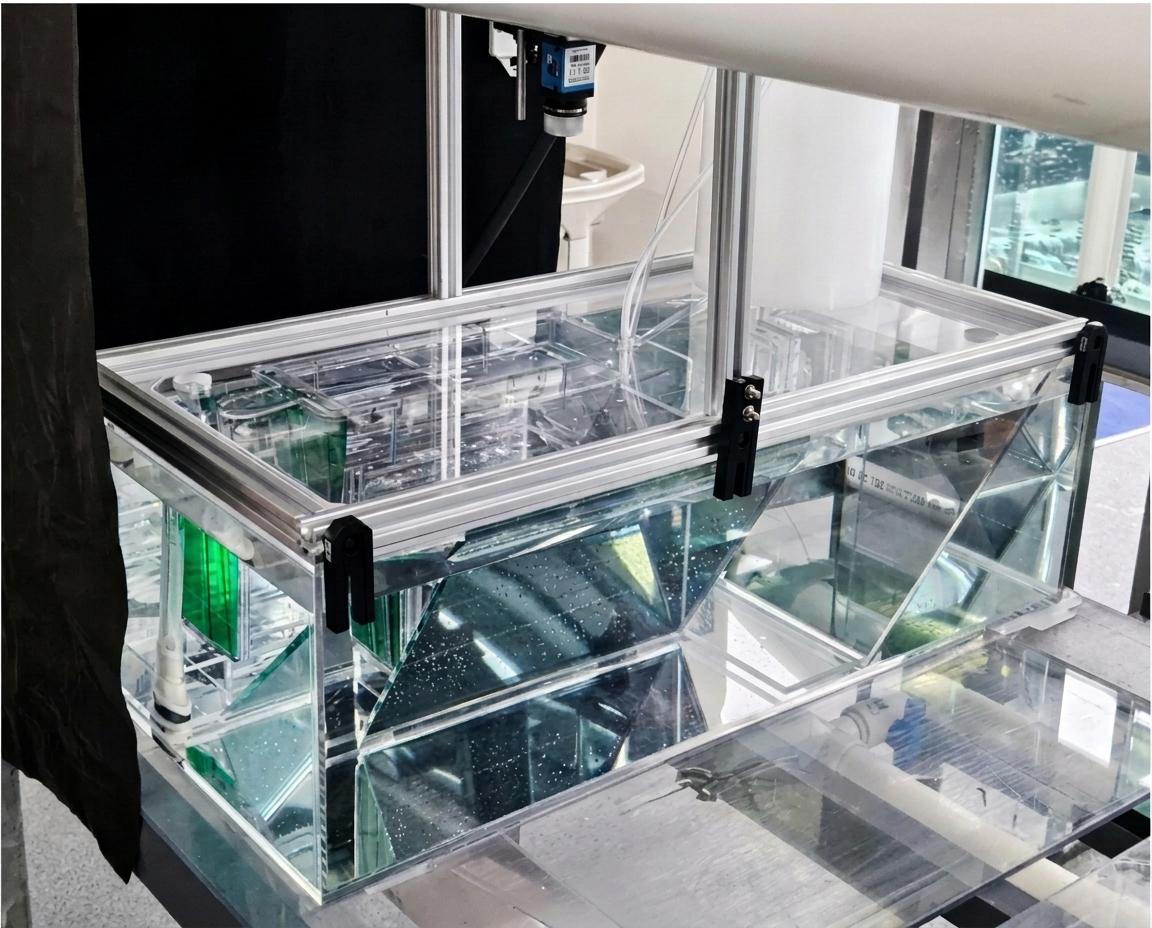
CanaryTank 3D
A mirror at 45° along the side of the aquarium puts the top view and the side view in the same image. The fish's vertical position in the water column adds behavioral information. The side view can be used on its own, for example to trigger alerts, or combined with the top view to obtain each fish's three-dimensional coordinates.
Shown here in an earlier prototype with an aluminum frame. Current units use the all-acrylic construction.
PiscisTrack™ comes with every CanaryTank
Every CanaryTank includes PiscisTrack™, our software and data interface. It measures activity, food-particle counts and group position on every image; shows live and historical data in a browser dashboard; replays imagery in sync with charts; sends email alerts within seconds of an event; and exports analyzed data for your own statistics.
Assembled by your team, no tuning required
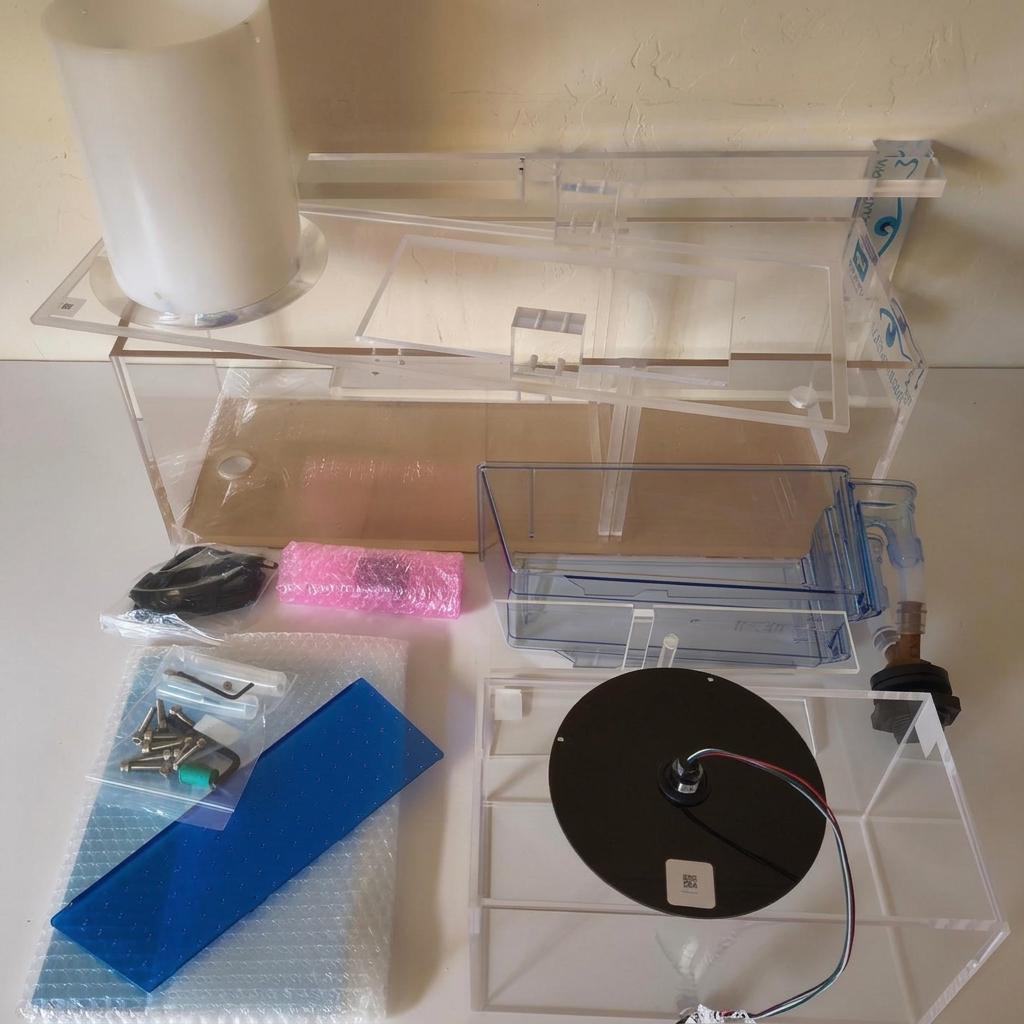
CanaryTank arrives in one package, with the camera pre-focused and the laser module pre-aligned. Assembly takes nine bolts and follows written and video instructions, with no on-site fine-tuning.
Maintenance includes 24/7 monitoring for hardware failures, with alerts if the camera or laser fails. Spare pre-focused camera and pre-aligned laser modules can be swapped in using the same instructions.
Freshwater and saltwater
CanaryTank works in both freshwater and saltwater systems. It was designed for zebrafish, and we welcome inquiries from other aquatic-animal facilities.
Continuous day and night recording in the fish facility
CanaryTank uses near-infrared, invisible to the fish, and creates a darkfield so that the camera, which filters incoming light, only records the fish, which appear bright against a dark background. Thanks to this patented design, CanaryTank can operate in the fish facility day and night without needed protection from ambient light and without disturbing the fish.
The sentinel aquarium sits inside a larger acrylic container. The near-infrared light is generated by a vertical laser beam, widened by a beam expander and deflected by a mirror so that it illuminates the fish horizontally. The overhead camera has a filter that rejects visible light and only sees the infrared light reflected by the fish. As a result, images are mostly black, and image files are very small, allowing sustainable storage of CanaryTank continuous output.
Using Remanent Imaging, each image records the fish's motion as continuous light trails. Incoming images are analyzed by PiscisTrack™, which generates alerts as needed and stores data and imagery.
CanaryTank is robust
CanaryTank has been thoroughly tested at ZIRC through the detection of daily events and blind tests
Daily test examples: feeding and light changes
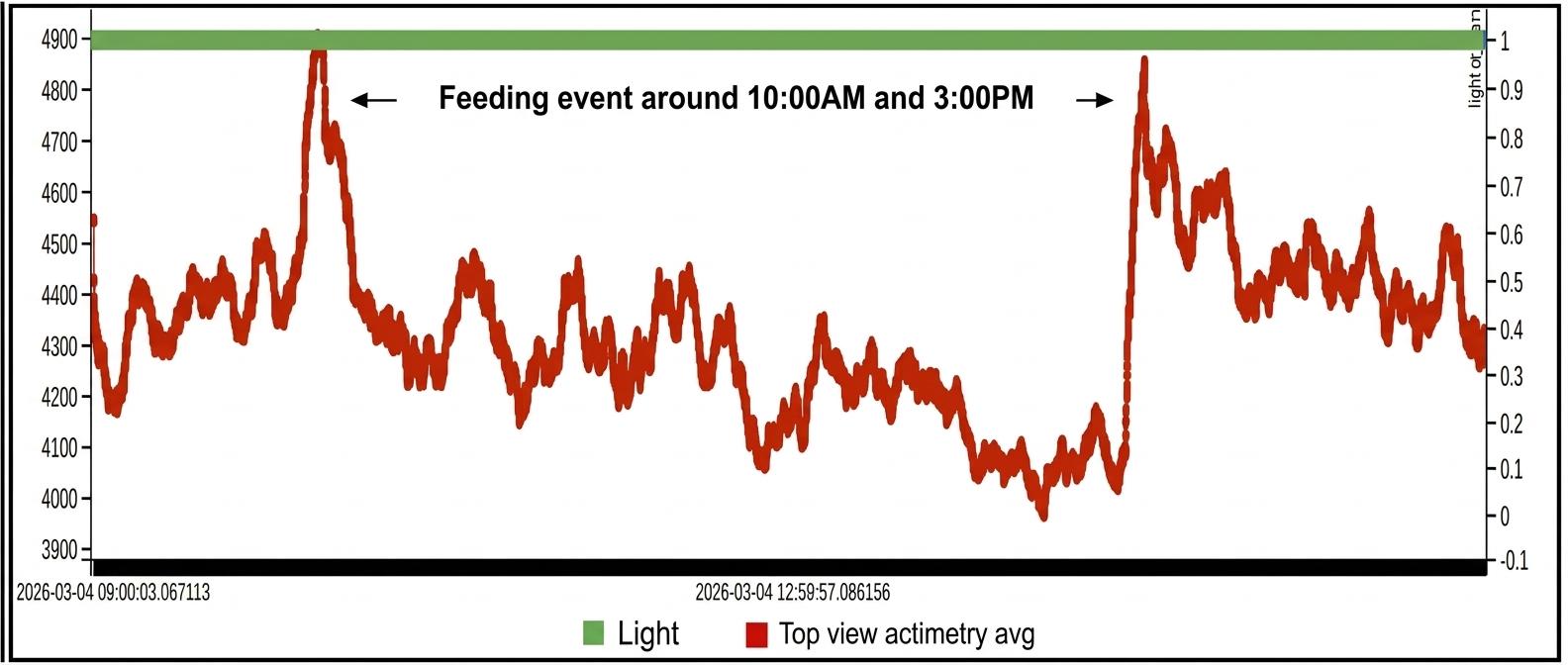
Feeding and the facility's light schedule produce predictable events every day. CanaryTank detects them as they happen: feeding shows up as a sharp rise in activity and food-particle count and triggers an email alert within seconds, and the fish's reaction to the facility lights turning on is clearly visible in the activity data.
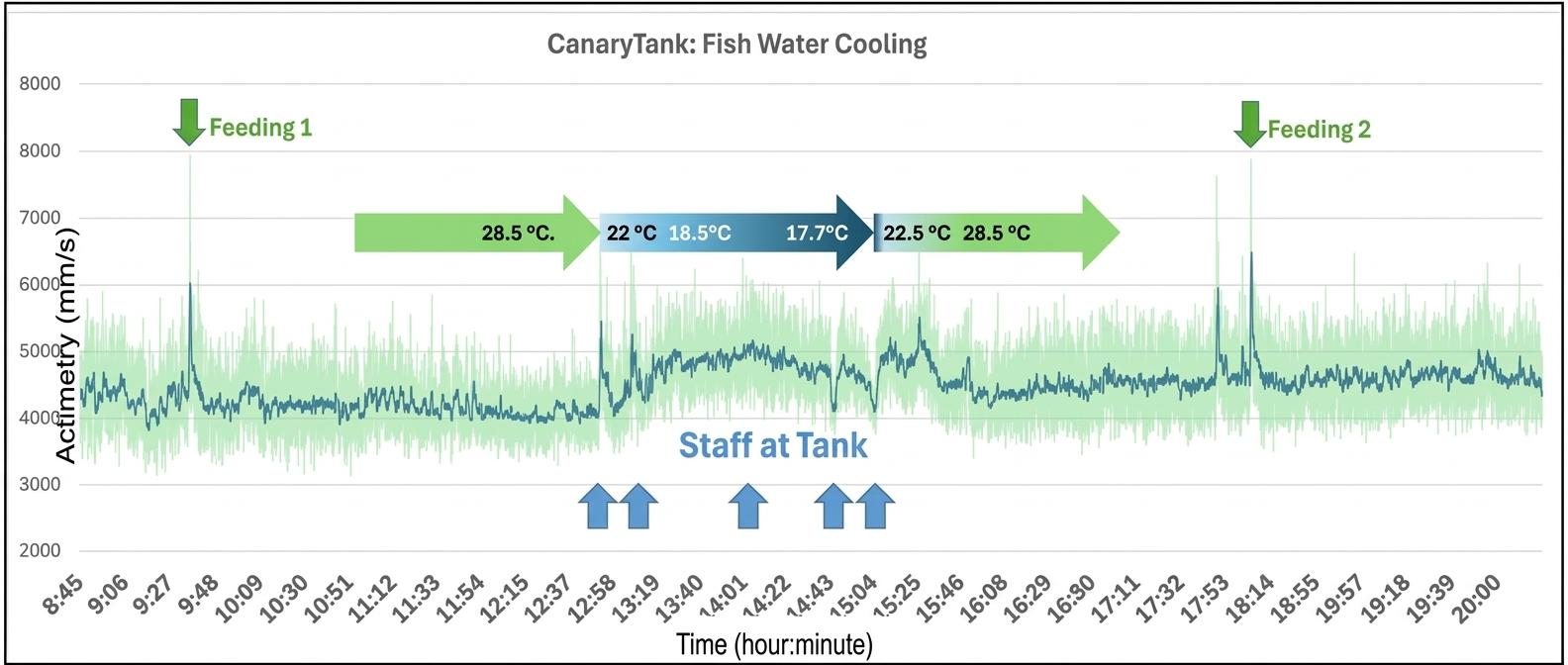
Blind test example: a water-cooling test
ZIRC ran a blinded, exploratory test in which water temperature was lowered over two hours and then restored. CanaryTank revealed subtle, sustained responses that routine observation did not show:
- group activity first rose, then fell as temperature dropped
- the response to an approaching person inverted, from spikes to dips
- activity stayed elevated after normal temperature was restored
Which version fits your facility?
Tell us about your racks, tanks and questions, and we will recommend a configuration.